Inside the technology stack — from satellite-driven irrigation scheduling to pollination orchestration to processor-integrated traceability — that turns California's Central Valley into the world's dominant supplier of almonds and pistachios.
Few American agricultural sectors combine global market dominance, capital intensity, regulatory pressure, and operational sophistication as completely as the California tree nut industry. Almonds, pistachios, and walnuts together represent one of the most valuable crop categories produced anywhere in the United States, with a combined farm-gate value that consistently exceeds $9 billion in normal market years. California produces approximately 80% of the world's almonds and has overtaken Iran as the global leader in pistachio production, with walnut output also dominant in domestic markets and a substantial share of global exports.
What makes the California tree nut industry distinctive is not simply scale. It is the convergence of permanent crop economics, intensive water management under regulatory constraint, sophisticated pollination orchestration, integrated processing infrastructure, and ERP architectures purpose-built for high-value export-driven supply chains. This article examines how that operational system functions, why tree nut production demands a fundamentally different ERP architecture than commodity row crops, and where the industry is heading as water policy, climate, and market conditions reshape the landscape.
California's tree nut production is concentrated in the Central Valley, a 450-mile-long basin extending from Redding in the north to Bakersfield in the south. Within this basin, two sub-regions matter most.
The San Joaquin Valley, occupying the southern two-thirds of the Central Valley, is the heart of almond and pistachio country. Counties such as Fresno, Kern, Madera, Tulare, and Stanislaus host the dominant share of bearing acreage, with deep alluvial soils, long warm growing seasons, and historic access to surface water from the federal Central Valley Project and the State Water Project.
The Sacramento Valley, in the north, anchors the walnut industry and contributes meaningfully to almond production, with cooler conditions and different rainfall patterns than the south.
According to USDA NASS data, California's bearing almond acreage approached 1.4 million acres in recent years, with pistachio acreage exceeding 500,000 bearing acres and walnut acreage at approximately 380,000 bearing acres. Together, tree nuts cover more cropland in California than any other category — a remarkable shift from a generation ago when row crops, cotton, and dairy forage dominated the landscape.
This geographic concentration creates operational dynamics that have no parallel in commodity row-crop systems. The structural parallels with other irrigated specialty regions covered on AgriFlow ERP — including the Columbia Basin's farm efficiency systems and the broader California farm ERP landscape — provide useful reference points, though the permanent-crop economics of tree nuts impose constraints that even those high-management systems do not fully share.
The defining feature of tree nut production — and the source of much of its operational complexity — is the permanent crop nature of the orchards themselves. An almond tree may be productive for 20 to 25 years; a pistachio tree for 40 years or more; a walnut tree for similarly long horizons. This permanence reshapes every aspect of the operating model.
Several implications follow:
These characteristics make tree nut ERP architectures qualitatively different from commodity grain or even other specialty crop systems. Field history extends across decades; cumulative input records support both agronomic management and regulatory documentation; and asset-management dimensions — tree age, rootstock, replant decisions, removal scheduling — must be modeled natively rather than treated as adjacent data.
No discussion of California tree nut production is complete without addressing water. Tree nuts are inherently water-intensive crops. A bearing almond orchard typically requires 4 to 5 acre-feet of water per acre per year; pistachio orchards somewhat less but still substantial; walnut orchards similar to almonds. Across roughly 2.3 million bearing acres of tree nuts in California, this represents one of the largest agricultural water footprints in the United States.
The challenge is that California's water supply has become structurally constrained. Recurring droughts — most acutely in 2012-2016 and again in 2020-2022 — have reduced surface water deliveries below historical levels. Groundwater overdraft has triggered land subsidence in some districts. And the Sustainable Groundwater Management Act (SGMA), passed in 2014 and now in active implementation, requires basins across the Central Valley to achieve groundwater sustainability by 2040, with binding restrictions tightening progressively through the 2030s.
The implications for tree nut operations are profound. Several adaptive responses are visible across leading orchards.
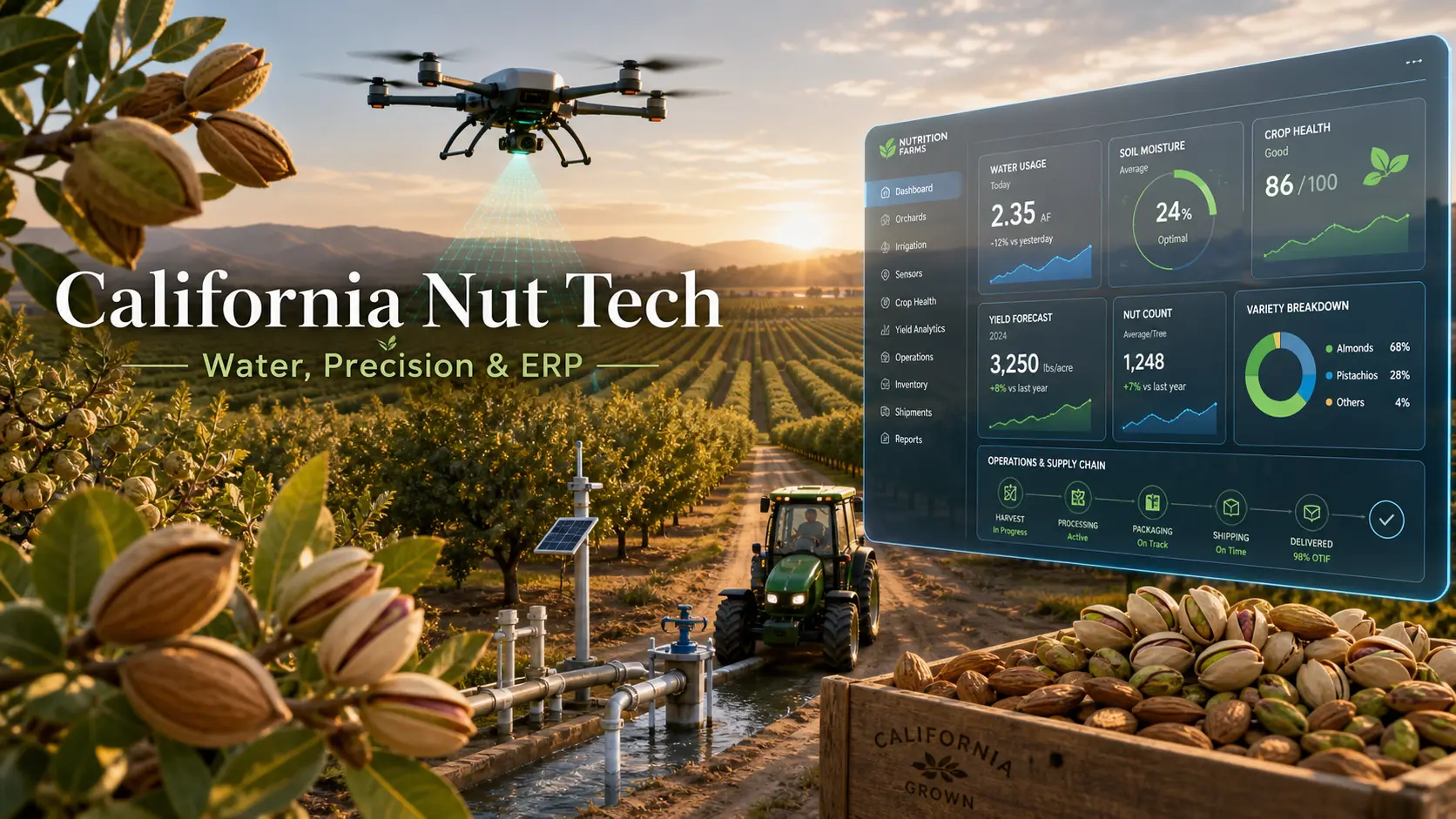
Modern California tree nut orchards now routinely deploy soil moisture probes at multiple depths, plant water status sensors (stem water potential measurements have become standard), evapotranspiration-based scheduling algorithms, and satellite-derived crop water demand models. Rather than applying water on calendar schedules, leading operators irrigate based on real-time crop water status and projected demand. The methodologies extend the principles examined in our analysis of drone-based irrigation management in California and the broader practices documented in our coverage of water management strategies for drought-resilient cropping.
Drip and micro-sprinkler systems have largely displaced flood irrigation across California tree nut acreage, though some older orchards remain on furrow systems. The conversion has reduced water application rates by 20 to 30% on average while improving uniformity and enabling fertigation — the delivery of nutrients through irrigation water at finely controlled rates and timings.
Within orchards, soil texture variation, topography, and tree-by-tree productivity differences create opportunities for variable-rate water management. Modern micro-irrigation systems with pressure-compensating emitters and zoned valve control can deliver substantially different volumes to different orchard sections, optimizing water use against productivity outcomes.
ERP systems for California tree nut operations must now natively handle SGMA-related documentation: groundwater pumping records, allocation tracking, transfers between wells and parcels, and reporting to local groundwater sustainability agencies. This regulatory layer is non-trivial and continues to intensify; operators without integrated documentation systems face genuine commercial risk.
Almonds are entirely dependent on insect pollination — primarily by managed honey bees — to set a crop. The California almond industry consumes approximately two-thirds of the commercial honey bee colonies in the United States during the late-February through early-March bloom period, with hives transported by truck from across the continent in what represents one of the largest insect migrations on Earth.
The operational complexity is substantial. A typical bearing almond orchard requires two to three hives per acre, contracted from beekeepers months or years in advance. Hive placement must be timed to bloom progression. Hive strength (frames of bees per colony) is graded and affects pricing. Weather during bloom — temperature, wind, rainfall — directly determines pollination success and ultimate yield.
Pistachios, in contrast, are wind-pollinated, but require careful matching of male and female trees in alternating rows with synchronized bloom timing — a different agronomic challenge that nonetheless demands precise field-level documentation.
ERP systems for almond operations must natively handle:
This dimension of orchard management is one of the most distinctive features of California tree nut production. Few other agricultural systems require the orchestration of a continent-spanning biological supply chain to produce their crop.
Tree nut orchards have become showcases for precision agriculture deployment, partly because the high per-acre value of decisions justifies investment that smaller-margin crops cannot support.
Routine multispectral imagery — from satellites, aircraft, and drones — informs irrigation management, nutrient deficiency detection, disease scouting, and yield estimation. Tree-by-tree productivity mapping has become commercially viable, allowing operators to identify underperforming trees for replacement or remediation. The methodologies parallel and in many ways pioneered the broader agtech innovations transforming modern farms we have documented across other production regions.
The California tree nut industry has been an early and aggressive adopter of plant-based water status monitoring. Stem water potential measurement using pressure chambers — once a research technique — has become standard commercial practice. Newer technologies including continuous stem water potential sensors and thermal imaging are extending the granularity and frequency of plant stress data available to managers.
Tree nut orchards demand precise nutrient management. Nitrogen, potassium, zinc, boron, and other elements must be balanced against crop removal, soil reserves, and fertigation delivery. Variable-rate applications based on soil and tissue testing are now routine on commercial-scale operations.
Hull rot in almonds, navel orangeworm pressure in both almonds and pistachios, Botryosphaeria dieback, and a range of other disease and pest threats demand sophisticated modeling and monitoring. Integration of weather data, regional pest pressure surveillance, and orchard-specific history into ERP-linked decision support has become a major application of artificial intelligence and machine learning in farm management within the industry.
Almond and pistachio harvests are highly mechanized, involving shaking machines that vibrate trees, sweepers that collect product from orchard floors (in conventional almond systems), and pickup and conveyance equipment that moves harvested product to roadside totes or trailers. Modern equipment generates telemetry data on shaking duration, sweeper coverage, and pickup efficiency, feeding into operational analytics that optimize harvest timing and equipment deployment.
Tree nuts move from orchard to consumer through a multi-stage processing infrastructure that is integral to the industry's commercial structure.
For almonds, the typical sequence is:
For pistachios, the sequence centers on rapid post-harvest processing to prevent staining and aflatoxin development, with critical timing windows measured in hours rather than days.
The processing sector is dominated by a relatively small number of large hullers, shellers, and integrated handlers. Some operate as grower cooperatives (Blue Diamond Growers being the largest almond cooperative globally); others as independent processors purchasing from grower-suppliers; and increasingly as integrated grower-processor-marketer entities that span the full value chain. Major firms including Wonderful Pistachios & Almonds, Setton Farms, and a range of regional operators have built substantial market positions.
The ERP implications of this structure are substantial. Tree nut operations must integrate seamlessly with their handler relationships, providing pool accounting, lot-level traceability, quality grade reconciliation, and increasingly real-time delivery and inventory data. The operational principles — though scaled differently — share substantial overlap with the processor-integrated supply chains we have documented in our analysis of Idaho's potato industry and the Florida citrus ERP landscape.
Tree nuts are the most export-intensive of California's major crops. Approximately 70% of California almond production is exported, with leading destinations including the European Union (Germany, Spain, the Netherlands), India, China, and the Middle East. Pistachio exports show similar profiles, with China historically a dominant destination subject to substantial year-over-year variability driven by tariff and trade policy.
This export dependence creates several ERP demands.
Different export markets impose different specifications. EU buyers require maximum aflatoxin levels below specific thresholds; Indian buyers may emphasize visual size grading; Chinese buyers may emphasize specific size and color profiles; Middle Eastern buyers operate on specifications oriented toward retail consumer markets. Lot allocation against contract specifications is a real-time ERP function.
Phytosanitary certificates, country-of-origin documentation, customs paperwork, and certification of compliance with importer-specific protocols all flow from operational ERP data. Reconstruction of these records retroactively is expensive and error-prone.
Tree nut export pricing is conducted in U.S. dollars, but downstream demand and competing supply (Spanish almonds, Iranian pistachios, Australian almonds, Turkish pistachios) operate across multiple currencies. The grain risk management principles examined in our coverage of grain risk and futures ERP integration apply here, though tree nut markets lack the deep futures liquidity that commodity grains enjoy — risk management is conducted primarily through forward physical contracting.
European retail buyers, Japanese specialty importers, and increasingly North American natural food channels require lot-level traceability supporting sustainability, organic, or quality claims. The infrastructure required mirrors the principles examined in our coverage of blockchain-enabled agricultural transparency, with the California tree nut industry serving as one of the higher-leverage applications of these technologies.
A tree nut-capable ERP must natively model dimensions that commodity row-crop platforms typically do not handle well.
Permanent crop asset management. Trees are long-lived productive assets with depreciation, replacement, and removal cycles fundamentally different from annual cropping. ERP must model orchard age, cultivar mix, rootstock, replant history, and removal/replant economics natively.
Multi-block, multi-cultivar segregation. A single ranch may contain dozens of orchard blocks with different cultivars, planting years, irrigation infrastructure, and contractual arrangements. Field-level identity must persist across decades.
Pollination management. For almond operations, hive contract administration is a first-class ERP function.
Water rights and SGMA compliance. Documentation must be audit-ready and integrated with operational data.
Handler integration and pool accounting. Settlement structures with hullers, shellers, and marketers vary substantially and demand sophisticated reconciliation capability.
Multi-currency export compliance. Quality specifications, certifications, and documentation must flow against contract-specific requirements.
Mobile-first field operations. Orchard managers, irrigation operators, harvest coordinators, and quality controllers all rely on real-time mobile access, applying the principles we have explored in our coverage of mobile applications connecting farmers to ERP systems.
These requirements make tree nut ERP one of the most demanding crop-specific implementations in U.S. agriculture. Generic agronomy platforms — even strong ones — typically struggle to model the permanent crop, pollination, water-rights, and handler-integration dimensions natively, leading to fragmented data architectures that undermine the operational visibility growers actually need.
The California tree nut industry has invested substantially in sustainability documentation, partly in response to consumer and retail buyer pressure and partly as a strategic response to water and regulatory scrutiny.
The California Almond Sustainability Program, operated by the Almond Board of California, has documented water use, pest management, energy efficiency, and labor practices across participating operations for more than a decade. Pistachio and walnut industry organizations operate parallel programs.
Carbon dimensions are also gaining traction. Tree nut orchards sequester carbon in standing biomass and soils, and emerging carbon market frameworks — explored in our coverage of carbon credit programs in agriculture — increasingly create potential revenue streams for operations with adequate documentation. Whole-orchard recycling, in which removed orchard biomass is chipped and incorporated into soils, has emerged as a significant carbon practice with measurable benefits.
The broader framework of climate-smart agriculture shapes both regulatory and commercial dynamics, with retail buyers in particular increasingly demanding documented sustainability performance as a condition of supply. ERP systems serving as the audit trail have become essential infrastructure rather than optional documentation.
Biotechnology and genetic improvement also matter. Newer almond cultivars including self-pollinating varieties are reducing pollination dependence and reshaping orchard economics. Pistachio rootstock improvements have expanded the range of suitable production environments. The interplay between these advances and operational data systems represents a meaningful application of biotechnology and crop resilience principles in the California context.
California tree nut orchards operate at sensor densities that significantly exceed typical broad-acre agriculture. A modern commercial orchard may deploy dozens to hundreds of soil moisture probes, weather stations, plant water status sensors, irrigation flow meters, and equipment telemetry devices. Increasingly, drone-mounted imagery and on-tractor sensors generate continuous data streams during operations.
Connectivity infrastructure has historically been adequate in most Central Valley operations, with cellular coverage supporting most field needs. The expansion of low-Earth-orbit satellite internet and continued cellular network upgrades have effectively eliminated remaining connectivity constraints. The fundamental architectures resemble those described in our overview of IoT in American farming, with the practical distinction that California tree nut operators have invested in higher sensor densities than most other U.S. agricultural sectors.
For practitioners and analysts seeking authoritative reference data, the Almond Board of California provides extensive industry research and statistics, while broader U.S. tree nut and specialty crop context is available through the USDA Economic Research Service.
The California tree nut model offers instructive contrasts with other specialty production regions covered on AgriFlow ERP.
Compared with Florida citrus operations, tree nuts share permanent crop economics and processor-integrated supply chains, but operate at substantially lower per-acre water requirements (citrus is even more water-intensive), face different disease pressures, and serve more export-driven markets.
Compared with Texas livestock operations or other livestock-dominant regions, tree nuts represent a fundamentally different ERP architecture — asset-intensive permanent crops with long capital horizons rather than turnover-based animal cycles.
Compared with the broader California farm ERP landscape covering vegetables, vineyards, and field crops, tree nuts dominate by acreage and value but require specialized ERP capabilities that general-purpose California farm platforms often lack.
Compared with the Texas-Oklahoma organic ERP model and other specialty production frameworks, organic California tree nut production exists but represents a smaller share than in many other specialty sectors, partly because of the agronomic challenges of organic pest management in long-cycle perennial systems.
Several trends are likely to define the California tree nut industry's next decade.
For California tree nut producers — and specialty crop operators more broadly — evaluating their digital infrastructure, several principles consistently distinguish successful deployments from underperforming ones.
These principles apply broadly to permanent crop ERP, but their cumulative weight in tree nut operations — driven by water-rights constraints, export complexity, processor integration, and pollination management — makes their disciplined application unusually consequential.
California's tree nut industry has built, over decades, one of the world's most sophisticated specialty crop production systems. The combination of geographic advantage, processor concentration, export market access, and accumulated agronomic and technological capability has produced an industry that operates at scales and precision levels few other crop sectors approach.
What makes the system distinctive is compounding integration. Permanent crop asset management compounds with multi-year water rights documentation. Pollination orchestration compounds with bloom-period weather records. Processor relationships compound with quality grade reconciliation. Export market documentation compounds with sustainability program participation. ERP infrastructure is the mechanism through which this compounding integration becomes operationally tractable — the data substrate that allows decisions made in 1.4 million acres of almond orchards, 500,000 acres of pistachio orchards, and the processing facilities that convert them into global commerce to inform one another consistently across years and decades.
For agribusinesses elsewhere, the California tree nut model offers more than a regional reference. It demonstrates how permanent crop economics, regulatory complexity, export-driven supply chains, and water-constrained production environments can be integrated into operationally coherent businesses through disciplined investment in digital infrastructure. The technology and approaches refined in the Central Valley increasingly define what high-intensity, sustainability-constrained, export-oriented agriculture looks like — and increasingly serve as a template for tree nut industries developing in Australia, Spain, Turkey, and elsewhere.
The Central Valley's tree nut empire is not the largest agricultural region by acreage, nor the most diverse by crop. But by the integration of biological, regulatory, commercial, and technological complexity it manages within a single coherent operational system, it stands as one of the most operationally sophisticated agricultural industries on Earth.
For continued analysis of how technology is transforming American specialty crop regions, explore our coverage of the Pacific Northwest crop yield landscape, the Mississippi Delta sustainable farming model, and the Northern Plains pulse crops ERP systems shaping U.S. specialty crop production.


Find Agriflow in other countries of Africa