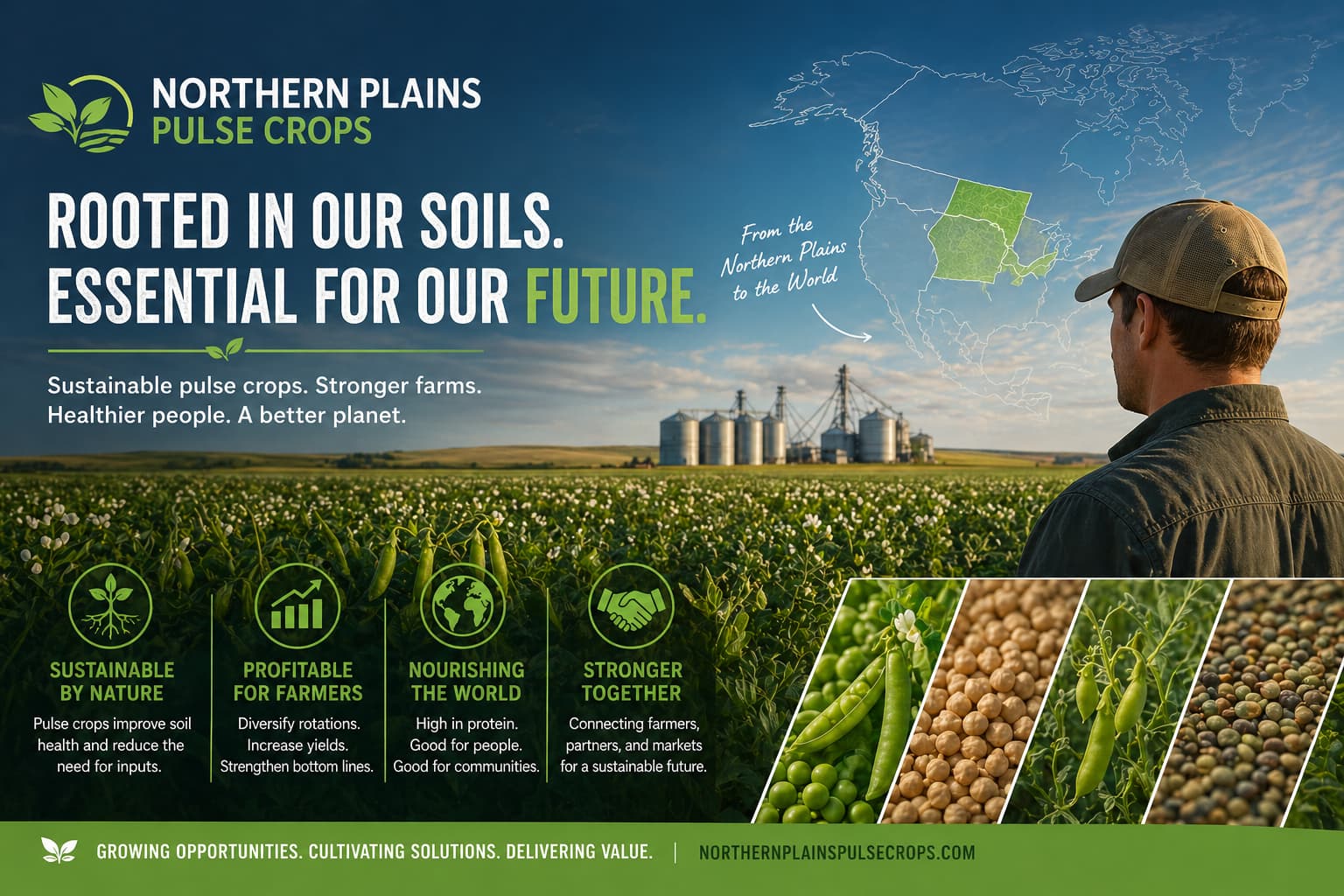
While public attention to American agriculture tends to fixate on corn, soybeans, and wheat, a quieter transformation has been unfolding across the Northern Plains. Over the past two decades, North Dakota, Montana, and parts of South Dakota have emerged as the United States' dominant production zone for dry edible peas, lentils, and chickpeas — collectively known as pulse crops. The U.S. now ranks among the world's leading exporters of these commodities, supplying high-protein staples to India, the European Union, the Middle East, and a rapidly growing domestic plant-protein industry.
What is making this expansion commercially viable is not just favorable climate and rotational fit. It is the convergence of precision agriculture, integrated ERP systems, and data-driven agronomy that allows producers to manage what is fundamentally a more complex crop portfolio than the corn-soybean monoculture of the Corn Belt. This article examines how the Northern Plains pulse industry has been built on a foundation of digital infrastructure, where the technology stack is heading next, and why the lessons from this region are increasingly relevant to specialty crop operations across North America.
The pulse-producing belt of the Northern Plains stretches from northwestern Montana eastward across northern North Dakota and into the lake-bottom soils of the Red River Valley. Climatically, it is a semi-arid to sub-humid zone with short growing seasons, cold winters, and erratic rainfall — conditions hostile to many crops but well-suited to cool-season legumes that complete their cycle before mid-summer heat arrives.
Two factors made this region a logical pulse heartland:
According to the USDA Economic Research Service, U.S. pulse acreage has grown from minimal levels in the early 1990s to over 2.5 million acres in recent years, with Montana alone accounting for roughly half of national lentil and chickpea production. North Dakota dominates dry pea production. This regional concentration is not coincidence — it reflects the agronomic logic of matching crops to environment, a principle increasingly enforced by the predictive modeling capabilities discussed in our coverage of Midwest crop prediction systems.
The strategic importance of the Northern Plains pulse industry has expanded sharply over the past decade for three converging reasons.
First, the global protein transition. Demand for plant-based protein ingredients — pea protein isolate in particular — has grown into a multibillion-dollar category. North Dakota now hosts some of North America's largest yellow pea fractionation facilities, with companies such as Roquette and AGT Foods operating processing infrastructure that converts farm-gate peas into ingredients used in dairy alternatives, meat analogs, and sports nutrition.
Second, geopolitical recalibration of pulse trade. India, the world's largest pulse consumer, periodically imposes and lifts import duties on lentils and yellow peas based on domestic production. These policy swings create both volatility and opportunity for U.S. exporters, making sophisticated risk management — of the kind we examined in our analysis of grain risk and futures ERP integration — essential rather than optional.
Third, sustainability premiums. Pulses fix atmospheric nitrogen biologically, reducing the need for synthetic fertilizer in subsequent crops by 20 to 40 pounds of N per acre on average. This places pulse production at the center of sustainability-linked finance and carbon market strategies, an alignment we have explored in detail in our coverage of regenerative agriculture and ERP infrastructure.
Pulse crops are agronomically less forgiving than commodity grains. Plant populations, inoculation quality, herbicide selection, and harvest timing all narrow the window for error. This is precisely why precision agriculture has been adopted earlier and more deeply in pulse operations than many observers realize.
Optimal plant populations vary dramatically by soil type, residue cover, and field topography. Yellow peas planted too thickly lodge severely; lentils planted too thinly yield poorly and lose to weeds. Modern pulse operations across Montana and North Dakota now routinely deploy variable-rate seeding prescriptions generated from multi-year yield maps, soil electrical conductivity surveys, and elevation data. The technical principles parallel those documented in our examination of Heartland soybean ERP and variable-rate management, but the agronomic stakes are higher because pulse crops do not compensate as effectively for poor stand establishment.
Effective biological nitrogen fixation requires that pulse seeds be inoculated with the appropriate Rhizobium strain at planting. Mismanagement of inoculant — exposure to heat, UV, or incompatible fertilizer contact — can reduce nodulation by half or more, with corresponding yield and protein consequences. Leading operators now track inoculant batches, environmental exposure, and field-level placement through their farm management systems. Inoculant supply chain visibility has become an ERP feature, not a binder of paper records.
Aphanomyces root rot, sclerotinia, and ascochyta blight collectively represent the largest yield risks across the Northern Plains pulse belt. Field history, soil DNA testing, and weather modeling now feed into rotation planning systems that recommend pulse re-entry intervals on a field-by-field basis. The shift from blanket "every four years" rules to data-driven, site-specific intervals has been one of the most economically impactful applications of artificial intelligence and machine learning in farm management in recent years.
Pulses are sold into specification-driven markets where seed coat color, splits, foreign material, and protein content directly determine pricing. Yield monitors integrated with grain quality sensors at the combine head are now generating spatial maps of not just yield, but quality — allowing operators to segregate higher-protein loads at the bin and command premiums in fractionation contracts. This represents a significant evolution beyond commodity-grade harvest management.
Many ERP platforms originally built for corn, wheat, and soybean operations struggle when applied to pulse production. The reasons are operational, not technological.
A typical Northern Plains pulse-grower's complexity profile includes:
A pulse-capable ERP must natively model identity preservation, multi-class crop segregation, and contract-level traceability. The shared design principles between robust grain ERP and pulse ERP are real, but the specialization is non-trivial. Operators who try to retrofit corn-belt platforms typically encounter friction at quality grading, contract management, and export documentation.
The mobile dimension is equally important. Pulse harvest windows are short, often disrupted by weather, and frequently involve multiple combines moving across distant fields. Real-time visibility into yields, moisture, and bin allocation through mobile interfaces — a topic we explored at length in our piece on mobile applications connecting farmers to ERP systems — is not a convenience feature for pulse operations. It is operationally essential.
The agronomic case for pulses overlaps almost completely with the sustainability case. Each acre of pulse crop in rotation:
These attributes have made pulses a focal point of voluntary carbon programs and sustainability-linked supply chain commitments. Major food companies — particularly in the European market — now offer modest premiums or preferred-supplier status for verifiable low-input pulse production, building on the kind of frameworks we have examined in our coverage of carbon credit programs in farming and climate-smart agriculture more broadly.
The data infrastructure required to claim these premiums is non-trivial. Operators must document field history, input use, equipment passes, and soil sampling protocols in audit-ready form. ERP systems are no longer just accounting tools in this context; they are the record of legitimacy that unlocks premium markets.
The Northern Plains pulse model has interesting parallels and contrasts with other specialized U.S. agricultural regions covered on AgriFlow ERP.
Compared with wheat farms across the Great Plains, pulse operations operate on similar acreage scales but with greater quality differentiation, more demanding agronomy, and higher per-acre revenue volatility. The two systems are typically rotational partners on the same farm, and integrated ERP coverage of both is operationally important.
Compared with Corn Belt ERP efficiency models, Northern Plains operations face shorter seasons, lower rainfall, and higher quality-spec dependence. Corn Belt platforms emphasize input optimization at the input dollar; pulse operations emphasize quality preservation at the contract dollar. Both are precision agriculture, but the kinds of precision differ.
Compared with Mississippi Delta sustainable farming systems or Appalachian precision farming approaches, Northern Plains pulse operations work at substantially larger scale per farm but face more compressed operational windows. The technology stack is similar; the deployment intensity differs.
Connectivity has historically been a more acute constraint in the Northern Plains than in the Corn Belt or Mississippi Delta. Population densities are low, terrestrial cell coverage is patchy, and many farms operate fields 20 to 40 miles from the operational headquarters.
The arrival of low-Earth-orbit satellite internet (Starlink in particular) since 2022 has transformed this situation. Combined with cellular IoT and on-premises mesh networks, modern pulse operations can now sustain real-time telemetry from machinery, soil moisture probes, and grain bin sensors across geographically dispersed footprints. The operational principles are essentially those described in our overview of IoT in American farming, with the practical caveat that Northern Plains operators have had to engineer redundancy more deliberately than their counterparts in better-connected regions.
Bin monitoring is particularly important in pulse operations. Pulses stored at improper moisture or temperature degrade rapidly, with corresponding loss of grade and price. Networked bin sensors with temperature and humidity logging — feeding directly into ERP-linked quality records — have become standard equipment on most commercial-scale pulse farms.
The economics of Northern Plains pulse production are driven heavily by export market dynamics that smaller operators historically struggled to engage with directly. Lentil prices can swing 30% in a season based on Indian import policy, Canadian production levels, and Black Sea geopolitical events. Yellow pea prices follow Chinese feed demand, European pet food formulation, and the trajectory of U.S. fractionation capacity expansion.
Sophisticated operators now integrate hedging strategies, forward contracting, and physical position management within their ERP systems, applying methodologies similar to those described in our analysis of grain risk and futures ERP integration. The added complexity for pulses is that liquid futures markets do not exist in the same way they do for corn or wheat — risk management is conducted primarily through forward physical contracts with processors and exporters, requiring careful counterparty management.
Export logistics from the Northern Plains add another layer. Most pulses move by rail to West Coast ports (Vancouver, Portland) for Asian destinations, by container through Chicago and Norfolk for European and Middle Eastern markets, or by direct truck and rail to fractionation plants in the region. Logistics visibility — load tracking, demurrage management, container booking — has become an ERP function, not an external service. The orchestration challenges resemble in some respects those documented in our piece on Midwest agricultural logistics, though with a more export-heavy profile.
Consider the operational profile of a representative 12,000-acre operation in northeastern Montana, a region where pulse rotations have largely replaced traditional wheat-fallow systems. A typical four-year rotation might include:
Across these rotations, the operation generates spatial yield data, equipment telemetry, soil sampling results, weather records, contract specifications, and storage data totaling several hundred gigabytes per season. Without integrated ERP infrastructure, that data sits in silos and decisions revert to intuition. With it, the operator can see — in near real time — which fields are tracking ahead of contract delivery commitments, which bins are at risk of quality deterioration, and which rotational decisions are paying off in nitrogen credit.
This is the operational reality that distinguishes commodity producers from specialty exporters. The technology is not optional. It is the difference between participating in premium markets and selling into commodity discount streams.
A meaningful and growing segment of Northern Plains pulse production targets organic and identity-preserved markets, which command significant price premiums. Organic lentils and chickpeas serve domestic natural-foods retailers and European buyers; identity-preserved non-GMO pulses (which is, technically, all commercial pulse production, but increasingly demands documentation) serve specific processor contracts.
The ERP demands of organic and IP production are substantial. Field history must be auditable for the full transition period; input applications must be logged at field-level granularity; comingling risks must be managed at every transfer point. The principles we have explored in our coverage of organic ERP profitability and the Texas-Oklahoma organic ERP model apply with full force in the Northern Plains pulse context, with the additional complexity of pulse-specific quality grading.
The genetic foundation underlying modern Northern Plains pulse production has advanced significantly. Public breeding programs at North Dakota State University and Montana State University, alongside private breeders, have released cultivars with improved disease resistance, faster maturity, and better quality profiles. Recent advances in chickpea breeding have substantially expanded the geographic range over which large kabuli types can be reliably produced.
The interplay between data systems and cultivar selection is becoming increasingly tight, with farm management platforms now recommending cultivar choices based on field-specific yield environment classifications, disease pressure history, and end-market quality requirements. This integration of biotechnology and crop resilience with operational data systems represents one of the higher-leverage applications of agtech in the region.
Several trends are likely to define the next phase of development.
For producers, processors, and ag-input suppliers tracking the U.S. pulse industry from outside, the official statistical and policy resources maintained by the USDA Economic Research Service provide the most reliable foundation for market analysis, while industry-specific commercial intelligence is centralized through the USA Pulses (American Pulse Association) industry organization.
For Northern Plains pulse producers evaluating their digital infrastructure, several lessons consistently emerge from successful deployments:
These principles are familiar to agribusinesses elsewhere, but the cumulative weight of pulse-specific complexity — multiple crop classes, identity preservation, export-driven economics, narrow harvest windows, biological inoculant management — makes their disciplined application unusually consequential in this region.
The Northern Plains pulse industry has not generated the headline attention captured by Cerrado soybean expansion or Corn Belt scale. It has nonetheless built one of the most sophisticated, data-driven, sustainability-aligned production systems in North American agriculture. North Dakota and Montana farmers now feed plant-protein supply chains that span from Indian dal markets to American protein-bar formulation plants, supported by an ERP and precision agriculture infrastructure that is more advanced than many industry observers appreciate.
For agribusinesses elsewhere, the Northern Plains pulse model offers a clear lesson: specialty production at scale is not a contradiction. With the right data infrastructure, identity preservation, quality differentiation, and rotational complexity become competitive advantages rather than operational burdens. The technology stack that makes this possible is mature, accessible, and increasingly the dividing line between premium-market participants and commodity-discount sellers.
The next decade of pulse industry development will be shaped less by what is grown, and more by how well it is documented, traced, and orchestrated. The Northern Plains has spent two decades building exactly that capability — and it shows.
For continued analysis of how technology is transforming American agricultural regions, explore our coverage of the Pacific Northwest crop yield evolution, Columbia Basin farm efficiency, Florida citrus ERP transformation, and Texas livestock ERP integration.

Find Agriflow in other countries of Africa