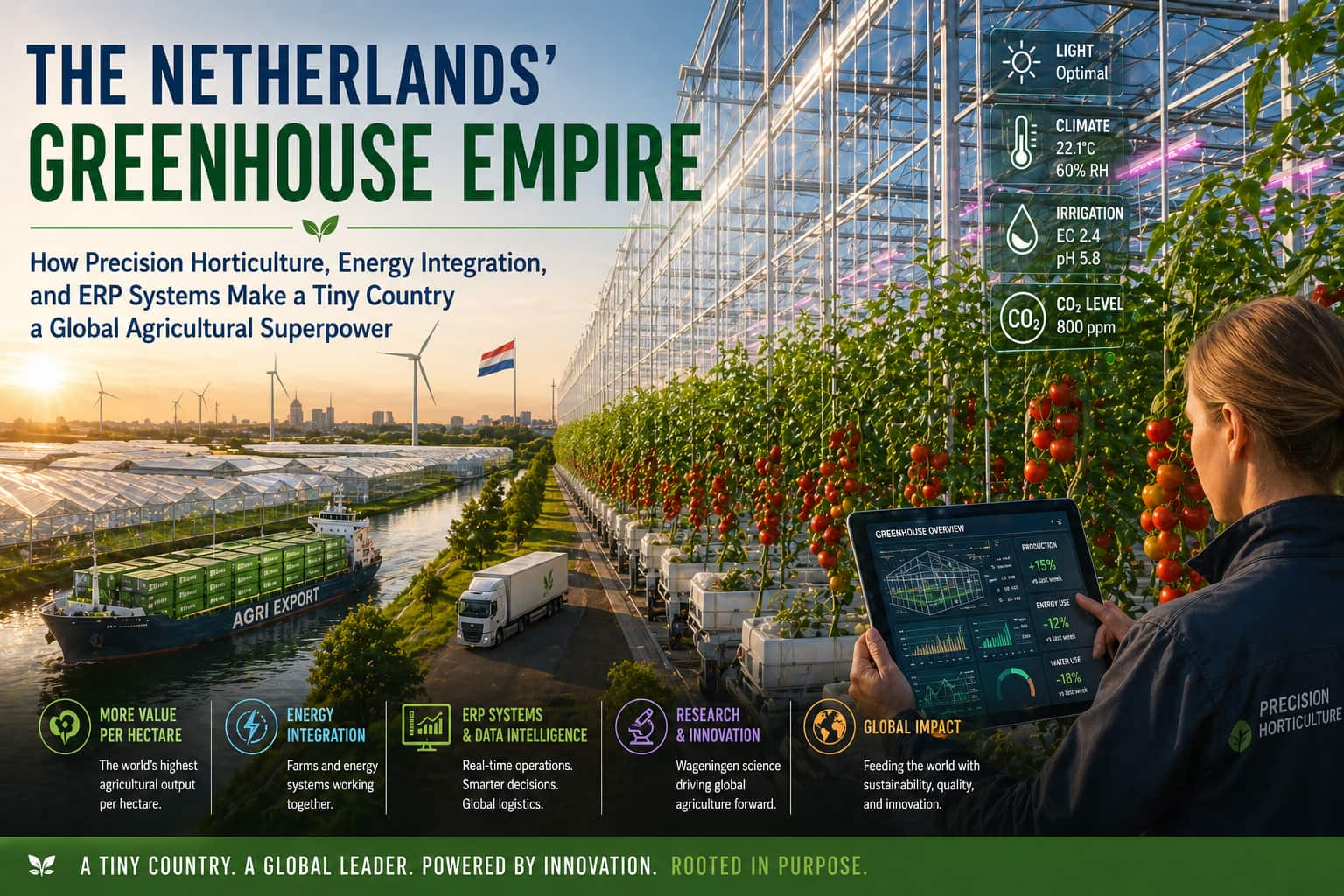
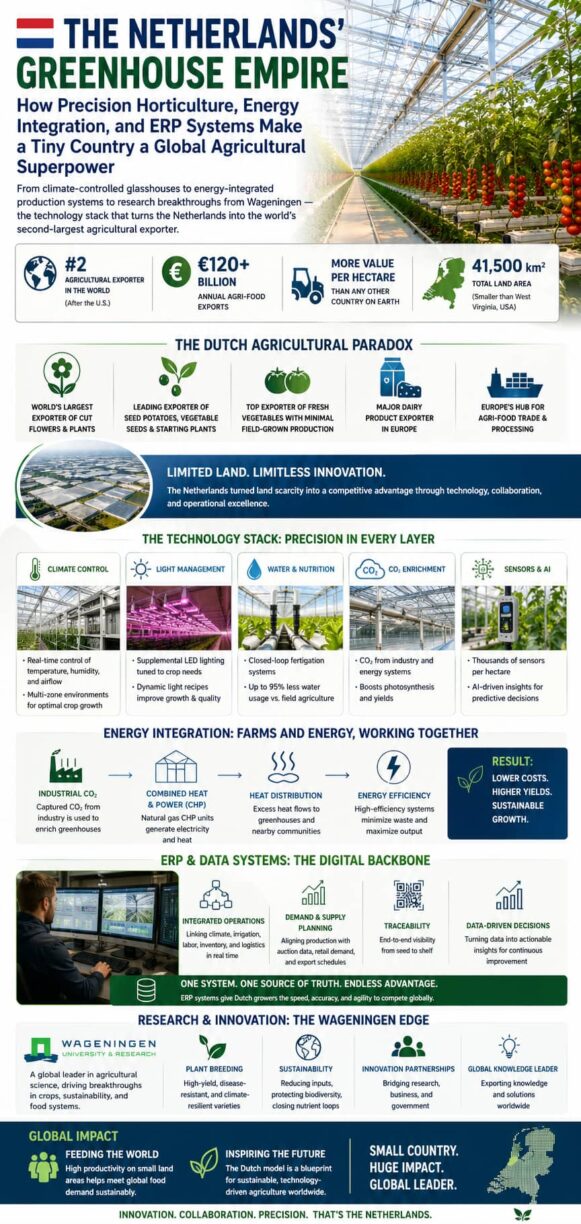
Inside the technology stack — from climate-controlled glasshouses to energy-integrated production systems to research breakthroughs from Wageningen — that turns the Netherlands into the world's second-largest agricultural exporter despite occupying less land than the U.S. state of Maryland.
The Netherlands occupies a position in global agriculture that seems to defy geography. With a total land area of approximately 41,500 square kilometers — smaller than the U.S. state of West Virginia — and a population density among the highest in Europe, the country produces and exports agricultural products at a value that consistently places it second only to the United States. Annual Dutch agri-food exports exceed €120 billion, supplying tomatoes to Germany, cut flowers to North America, dairy to East Asia, and seed potatoes to dozens of countries. According to Eurostat data, the Netherlands generates more agricultural value per hectare than any other country on Earth.
What makes this possible is not natural abundance. It is the convergence of world-leading controlled-environment agriculture, deep integration between energy systems and crop production, intensive precision livestock management, and ERP infrastructures purpose-built for just-in-time European logistics. This article examines how that operational system functions, why the Dutch model has become the global reference for high-intensity agriculture, and where the industry is heading as nitrogen regulations, energy transition, and labor pressures reshape the landscape.
The Netherlands' agricultural success is the product of several centuries of accumulated capability — but its modern form took shape in the post-1945 era, when the country deliberately chose intensification as a national strategy. With limited land, abundant water, exceptional logistics infrastructure (Rotterdam is Europe's largest port, Schiphol Airport is a global cargo hub), and proximity to wealthy European markets, the country bet on producing high-value agricultural goods at extreme efficiency.
The bet succeeded. Today the Netherlands is:
The strategic question this raises — for agribusinesses globally — is how the operational model actually works. Land scarcity drove intensification; intensification drove technology adoption; technology adoption demanded data infrastructure; and data infrastructure became a competitive advantage in itself. The result is a model that combines agronomic precision with industrial-grade operational discipline.
This profile contrasts sharply with the broad-acre commodity systems documented across most of our coverage, including the Heartland soybean ERP belt and the Brazilian Cerrado expansion model. Where those systems optimize across millions of hectares, the Dutch model optimizes within square meters of glasshouse floor space — a fundamentally different operational logic that nonetheless shares many of the same underlying data principles.
The geographic heart of Dutch horticultural production is the Westland region, a strip of land between The Hague and Rotterdam that contains the highest concentration of glasshouses on Earth. From above, the area is unmistakable: tens of thousands of hectares of glass roofing reflecting sunlight in tightly packed rectangles. Adjacent to Westland, the Aalsmeer flower auction (now part of the merged Royal FloraHolland) handles the daily orchestration of cut flowers and ornamental plants from across the world, with logistics speeds measured in hours from grower to overseas consumer.
The numbers are remarkable. The Netherlands operates approximately 9,000 hectares of greenhouse production, of which a substantial majority is fully climate-controlled high-tech glasshouses producing at industrial scale. A single modern tomato glasshouse may extend across 20 to 60 hectares under one roof, with environmental conditions actively managed across every cubic meter. Annual yields per hectare for greenhouse tomatoes routinely exceed 80,000 kilograms — more than 30 times the productivity of typical field-grown tomato systems.
This intensity creates operational dynamics that have no parallel in field agriculture. Decisions about temperature, humidity, CO₂ concentration, light spectrum, irrigation, and nutrition are made on minute-to-minute timescales by automated control systems integrated with sensor networks of unprecedented density. The technology stack overlaps with — and in many ways pioneered — the controlled-environment principles we have explored in our coverage of vertical farming systems in the UAE, though the Dutch model operates at scales and through commercial maturation curves that other regions are still working toward.
A modern Dutch high-tech glasshouse manages four interlocking environmental dimensions, each instrumented and controlled to a precision that would seem excessive in any field crop context.
Temperature, humidity, and air movement are managed through computer-controlled venting, screening, heating, and dehumidification systems. Multi-zone control is standard, with separate environmental regimes maintained across different sections of large glasshouses to match crop development stages. Modern climate computers — historically dominated by Dutch firms such as Priva and Hoogendoorn — process inputs from hundreds of sensors and adjust outputs through actuators distributed throughout the structure.
Northern European latitudes provide insufficient natural light during winter months for year-round production at commercial intensity. Dutch growers responded by deploying high-pressure sodium lighting at industrial scale, and more recently by transitioning to LED systems with tunable spectra. The energy implications are enormous — supplemental lighting alone can consume more electricity per hectare than the entire urban load of a small town — and energy strategy has become inseparable from production strategy.
Modern Dutch glasshouses operate closed-loop irrigation systems in which water and nutrients are delivered to substrate-grown plants (typically rockwool), drainage water is collected, sterilized, rebalanced, and recirculated. Water use efficiency in these systems exceeds 90% by some measures — meaning for every liter of water transpired by the crop, less than 0.1 liter is lost to drainage discharge. The principles examined in our coverage of water management strategies for drought-resilient cropping reach their fullest commercial expression in Dutch glasshouse systems.
Tomato, cucumber, and bell pepper glasshouses are routinely enriched to CO₂ concentrations of 800 to 1,000 parts per million — roughly double atmospheric levels — to accelerate photosynthesis. The CO₂ comes from combustion of natural gas in on-site combined heat and power (CHP) units, or from external industrial sources delivered by pipeline. This integration of CO₂ supply with energy generation is one of the defining features of the Dutch model and has no real parallel in other agricultural systems.
If technology defines the visible Dutch model, energy integration defines the economic one. Modern high-tech glasshouses are simultaneously crop production facilities and decentralized energy nodes, generating, consuming, storing, and trading electricity and heat in real time.
Combined heat and power (CHP) generators at glasshouse sites burn natural gas to produce electricity (sold to the grid during peak-price periods), heat (used to warm the glasshouse), and CO₂ (delivered directly to the crop canopy). The system effectively turns each greenhouse into a small power plant whose primary "byproduct" happens to be food and flowers.
Increasingly, this model is evolving toward renewable integration:
The ERP implications are substantial. A modern Dutch horticultural operation must manage:
This complexity is qualitatively different from anything in field agriculture. ERP systems serving Dutch glasshouses must natively model energy operations alongside agronomic operations — a requirement that rules out most platforms designed for broad-acre or even other specialty crop applications.
Glasshouse production is labor-intensive. Tomato, cucumber, and pepper crops require constant pruning, deleafing, training, harvesting, and quality grading. Cut flower and potted plant operations involve even more discrete handling. Historically, this labor was supplied by seasonal workers from across Europe — a supply that has tightened progressively in recent years.
The Dutch response has been aggressive automation investment. Robotic harvesters for tomatoes and cucumbers have moved from research prototypes to commercial deployment over the past five years. Automated grading and packing lines, driven by computer vision systems, now handle products that previously required human inspectors. Self-driving internal logistics platforms move plants between production zones with minimal human intervention.
The integration of these systems into the broader operational data architecture is the next frontier. Robotic harvesters generate detailed yield, quality, and disease data at individual-plant resolution. Translating that volume of data into actionable agronomic insight — and integrating it with ERP-level commercial decisions — represents a substantial application of artificial intelligence and machine learning in agricultural management, with the Netherlands serving as a global laboratory for what robotic-augmented horticulture will look like industry-wide.
No discussion of Dutch agriculture is complete without addressing Wageningen University & Research (WUR), widely regarded as the world's leading agricultural and food research institution. Located in the eastern Netherlands, WUR combines university teaching with applied research institutes covering plant breeding, livestock, food technology, environmental sciences, and economics.
What distinguishes Wageningen is the depth of its integration with industry. Dutch agribusiness companies — from glasshouse equipment manufacturers to dairy cooperatives to seed breeders — collaborate routinely with WUR on applied research, technology development, and commercialization. Many of the technologies that appear in Westland glasshouses originated in Wageningen labs five to ten years earlier.
This research-industry pipeline is not exclusive to Wageningen. Universities of applied sciences (HAS, Inholland, Aeres), private R&D centers, and the World Horti Center serve specialized roles. Together they produce a steady stream of agronomic, technological, and operational innovations that reinforce Dutch competitive advantages.
For practitioners and analysts seeking authoritative reference data on Dutch and broader European agriculture, the Wageningen University & Research portal provides extensive technical documentation, while comparable European production and trade context can be cross-referenced through Eurostat's agricultural statistics.
While horticulture captures international attention, dairy production remains a foundational pillar of Dutch agriculture. The Netherlands is one of Europe's largest dairy producers, with approximately 1.5 million dairy cows on roughly 16,000 commercial farms producing high-quality milk for processors including FrieslandCampina (a major global dairy cooperative) and a range of specialty cheese makers.
Dutch dairy operations have intensified significantly over the past several decades. Robotic milking systems are widespread, with Netherlands-based Lely being the global market leader in voluntary milking systems. Precision feeding, reproductive management through activity monitoring, and individual-animal health analytics are mature commercial practices. The operational logic shares substantial overlap with the systems documented in our coverage of Midwest dairy ERP infrastructure, though Dutch operations typically work at higher per-cow productivity and tighter regulatory constraint.
Beef cattle, pigs, and poultry round out the livestock sector. Pork production in particular has historically been a significant export industry, with Netherlands ranking among Europe's leading producers despite ongoing structural pressures from environmental regulations. The integration of livestock manure with arable cropping — a circular nutrient cycle increasingly disrupted by environmental rules — has long shaped Dutch farm structure, an arrangement that aligns with the circular economy frameworks we have explored in other contexts.
The Dutch agricultural model faces an existential regulatory challenge that has no real parallel elsewhere: the nitrogen crisis. In 2019, a Dutch court ruled that the country's existing system for managing nitrogen deposition near protected nature areas violated EU habitat directives. The ruling effectively halted construction permits and triggered a multi-year political and economic upheaval that remains unresolved.
The agricultural implications are profound. The Netherlands' livestock density and intensive cropping systems generate ammonia and nitrogen oxide emissions that, despite decades of reduction policies, remain incompatible with strict habitat protection requirements. Successive government proposals have ranged from mandatory livestock buyouts to forced relocation away from protected areas, each generating significant farmer protests and political reconfiguration.
For ERP and farm management systems, the nitrogen crisis has accelerated several transformations:
The broader policy frameworks of climate-smart agriculture and carbon credit systems in farming have particular salience in the Dutch context, where environmental performance has become not merely a sustainability claim but a license to operate.
The Dutch agricultural environment imposes ERP requirements that few other countries demand simultaneously. A platform serving a Dutch horticultural or livestock operation must natively handle:
The mobile dimension is operationally essential. Glasshouse staff, livestock managers, logistics coordinators, and quality controllers all rely on real-time mobile access to operational systems, applying the principles we have explored in our coverage of mobile applications connecting farmers to ERP systems.
The traceability requirements are also exceptional. EU regulations require producer-level lot tracking for nearly all agricultural products entering retail channels, and Dutch operators have invested heavily in blockchain-enabled and digital traceability infrastructure to meet both regulatory and customer requirements.
The Dutch agricultural model depends on a logistics infrastructure that few countries can match. Rotterdam handles a substantial share of European food trade, including imports of feed ingredients (soybean meal from South America, grain from Eastern Europe) and exports of finished products. Schiphol Airport's perishables operation moves cut flowers from Aalsmeer to global destinations within hours of harvest. A dense road and inland waterway network connects production zones to processing, distribution, and export gateways with reliability measured in tens of minutes.
ERP systems serving Dutch agribusinesses must integrate tightly with this logistics ecosystem. Real-time freight booking, temperature-controlled chain monitoring, customs documentation, and last-mile coordination with European retail distribution centers are not adjacent functions — they are core operational capabilities. The orchestration challenges differ in character from those documented in our coverage of Midwest agricultural logistics, being defined more by speed and product-mix complexity than by geographic distance.
Dutch agriculture operates within one of the world's most demanding regulatory environments. Beyond the nitrogen crisis, several EU-level frameworks shape day-to-day operations:
The cumulative regulatory load is substantial, and ERP infrastructure has become the practical mechanism through which compliance is documented and demonstrated. Operators without integrated documentation increasingly find themselves at structural disadvantage versus those with it. The biotech dimension is also evolving, with EU policy on gene editing and novel breeding techniques continuing to shape what genetic tools — explored in our coverage of biotechnology and crop resilience — are commercially available.
Dutch glasshouses, livestock operations, and even open-field horticultural sites operate at sensor densities that significantly exceed typical broad-acre agriculture. A modern 30-hectare tomato glasshouse may deploy several thousand sensors monitoring climate variables, substrate moisture, plant water status, fruit size, disease indicators, and environmental flux measurements. Robotic systems generate continuous streams of computer vision data on plant health, fruit ripeness, and harvesting conditions.
The connectivity infrastructure supporting this density is mature and reliable. Wired networks dominate within glasshouse structures, supplemented by wireless coverage for mobile operations. Field operations and dairy farms rely on a combination of cellular, fixed wireless, and increasingly LEO satellite connectivity. The fundamental architectures resemble those described in our overview of IoT in American farming, with the practical distinction that Dutch operators have rarely had to engineer for connectivity scarcity.
The Dutch agricultural model offers instructive contrasts with other production systems covered on AgriFlow ERP.
Compared with the UAE vertical farming sector, Dutch glasshouses operate at substantially larger commercial scale, with longer regulatory and consumer maturity. The Netherlands has had decades to refine economic models, supply chain integration, and customer relationships that vertical farming operations elsewhere are still establishing.
Compared with U.S. specialty crop regions documented across our California farm ERP and Florida citrus ERP coverage, Dutch operations work at smaller field scale but vastly higher productivity per hectare and greater integration with downstream processing and retail.
Compared with emerging-market agricultural systems such as those examined in our coverage of Kenya's climate-resilient farming or Ghana's cocoa value chain, the Dutch model represents the opposite end of the agricultural development spectrum — capital-intensive, technology-saturated, regulatory-constrained, and export-oriented. The contrast is instructive precisely because it illustrates the diversity of viable agricultural models across global contexts.
Several trends will shape the Dutch agricultural sector's next decade.
For agribusinesses operating in or evaluating the Dutch market — and for operators globally drawing lessons from the Dutch model — several principles consistently distinguish successful technology deployments.
These principles apply broadly to high-intensity agricultural systems, but their cumulative weight in Dutch operations — driven by extreme productivity-per-hectare, regulatory density, and just-in-time export discipline — makes their disciplined application unusually consequential.
The Netherlands has built, over decades, one of the world's most sophisticated agricultural production systems. The combination of land scarcity, market access, technological investment, and research excellence has produced an industry that operates at productivity levels and regulatory complexity few other regions approach.
What ties the system together is integration. Energy and crop production are integrated. Research and industry are integrated. Logistics and farm operations are integrated. Regulatory compliance and commercial differentiation are integrated. ERP infrastructure is the mechanism through which this integration becomes operationally tractable — the data substrate that allows decisions made in glasshouses, dairy parlors, breeding labs, and trading rooms to inform one another in real time.
For agribusinesses elsewhere, the Dutch model offers more than a curiosity. It demonstrates that the most operationally sophisticated agriculture on Earth runs on integrated data infrastructure as much as on agronomic skill. The technologies and approaches pioneered in Westland glasshouses, Wageningen labs, and Friesland dairy farms increasingly define the operational frontier toward which much of global agriculture is moving — even where the underlying physical systems differ substantially.
The Netherlands' agricultural empire is small in geography and vast in operational ambition. Its ERP infrastructure is what binds the two together.
For continued analysis of how technology is transforming agricultural systems globally, explore our coverage of the broader agtech innovations transforming modern farms, South Africa's wine ERP infrastructure for another premium-export agricultural model, and the aquaculture ERP frameworks shaping seafood production worldwide.

Find Agriflow in other countries of Africa