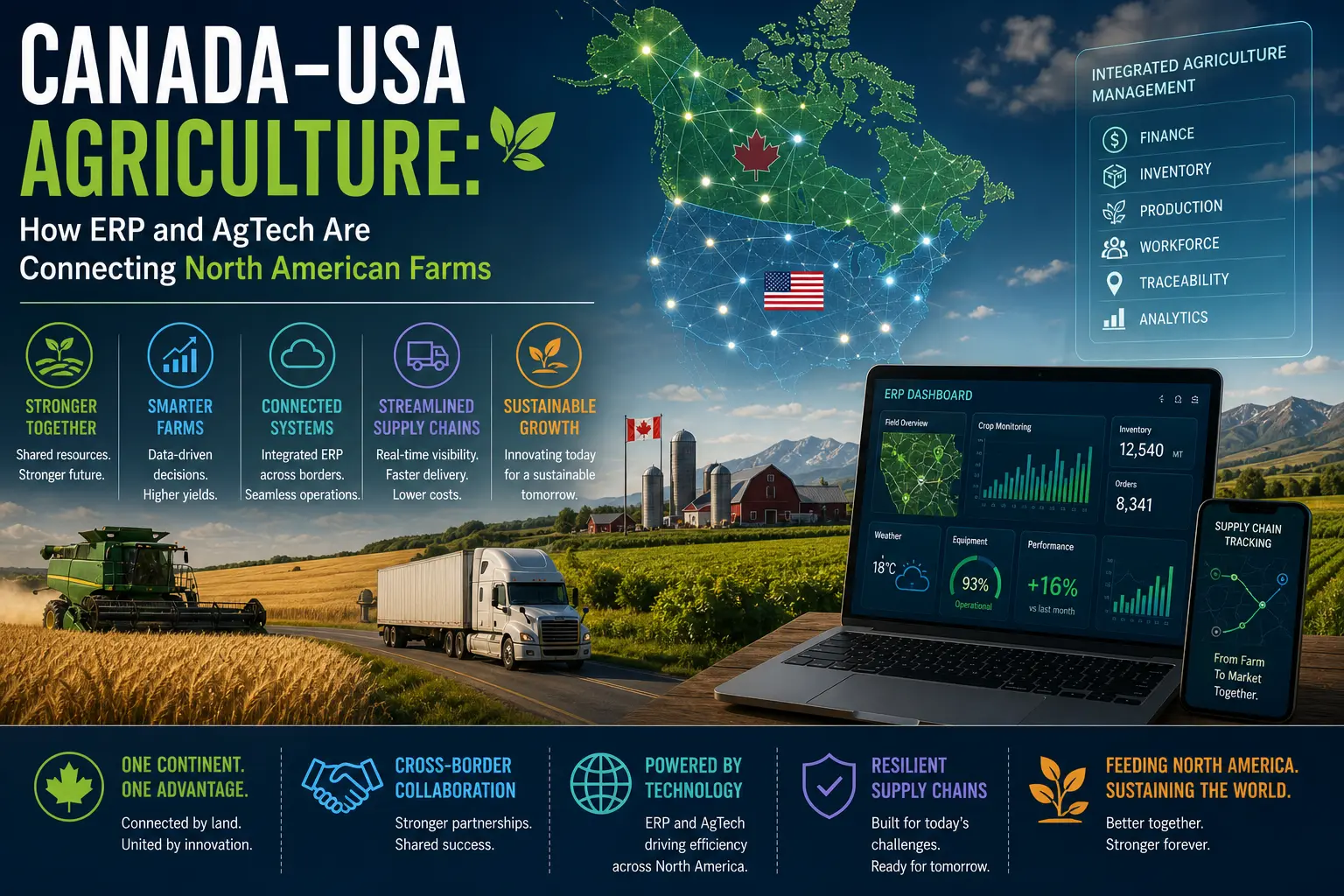
The Canada–United States agricultural relationship is one of the most consequential — and most technologically interdependent — food systems on the planet. The two countries share more than 8,800 kilometers of border, a deeply integrated grain and livestock trade exceeding USD 60 billion annually, and a continental supply chain that moves canola from Saskatchewan to Minneapolis crushers, dairy genetics from Wisconsin to Quebec, and Pacific Northwest apples to British Columbia distribution centers, often within hours.
What is changing fastest, however, is not the geography of trade but the digital infrastructure underneath it. Enterprise resource planning (ERP) platforms, IoT sensors, satellite-driven decision support, and blockchain traceability systems are quietly stitching together two national agricultural systems into something that increasingly behaves as a single North American operating environment. For farmers, cooperatives, and processors operating on either side of the 49th parallel, understanding how these tools interact has become a strategic necessity rather than a future-looking ambition.
Together, Canada and the United States cultivate over 200 million hectares of agricultural land and account for roughly one-third of global grain exports. The U.S. produces more than 90% of the world's corn surplus available for export and remains the largest soybean exporter, while Canada is the dominant force in canola and a top-three exporter of wheat, lentils, peas, and durum. According to the USDA Economic Research Service, Canada is consistently the United States' largest or second-largest agricultural trading partner, with two-way agri-food trade now structurally embedded in both economies.
This scale comes with complexity. A single bushel of canola may be planted in Manitoba, monitored by drones, scheduled for harvest by an ERP module synced with weather APIs, trucked across the Pembina border crossing, crushed in North Dakota, and finally shipped as biodiesel feedstock to California. Every step generates data — and every handoff is a potential source of friction, loss, or compliance risk. Modern ERP systems are increasingly designed around exactly this reality.
Twenty years ago, "farm software" meant a desktop application for tracking acreage and inputs. Today, agricultural ERP platforms unify finance, inventory, agronomy, compliance, traceability, and logistics into a single source of truth. For operations spanning Canada and the U.S., this consolidation matters even more, because farmers are simultaneously managing two currencies, two tax systems, two regulatory regimes (Canadian Food Inspection Agency and USDA/FDA), and the layered USMCA rules of origin that determine tariff treatment.
Producers running enterprises in both countries — increasingly common in the wheat belt and the dairy industry — are turning to integrated systems for reasons that mirror the principles described in our analysis of large-scale ERP deployments in California and Texas. The same operational logic that helps a 20,000-acre Texas operation manage geographically dispersed fields applies, with regulatory adjustments, when those fields straddle Saskatchewan and North Dakota.
The benefits typically reported by cross-border operators include:
The Northern Great Plains and the Canadian Prairies are, ecologically and economically, a single agricultural system arbitrarily bisected by an international boundary. Soils, weather systems, pest pressures, and even the major grain-handling cooperatives often span both jurisdictions. The technology adoption patterns reflect this continuity.
Canadian prairie producers have, in many cases, leapfrogged their U.S. neighbors in the adoption of variable-rate canola seeding and integrated farm management software, partly due to the consolidation of the Canadian Wheat Board era and the subsequent need for individual marketing decisions. South of the border, the patterns described in our piece on wheat farms across the Great Plains show similar trajectories: precision agriculture is no longer a competitive edge but a baseline expectation.
What is genuinely new is the integration layer. A producer farming both Manitoba and North Dakota land can now run a single yield-mapping workflow, ingest data from John Deere Operations Center or Climate FieldView, and reconcile harvest tonnage across two grain elevators in different countries — all within the same ERP instance. This kind of operational coherence simply was not possible five years ago. Operations that have studied the lessons from Cornbelt ERP efficiency strategies are now applying the same principles to dual-country grain enterprises.
Canola is a uniquely Canadian success story — a crop bred at the University of Manitoba in the 1970s that now generates over CAD 30 billion in economic activity. But its supply chain is intensely continental. Roughly half of Canadian canola exports flow into the U.S. as seed, oil, or meal, feeding both the renewable diesel boom and Midwestern livestock operations.
This integration creates fascinating cross-pollination with the soybean economy described in our coverage of the Heartland soybean ERP landscape. Crushers in the U.S. Midwest are increasingly designed to handle both crops, and renewable fuel mandates are creating shared price signals across the border. ERP systems that can model dual-crop, dual-currency contracts — and that integrate with futures markets — have become essential, building on the kind of analytics described in our examination of grain risk and futures-aware ERP.
Dairy is where the Canada–USA agricultural relationship is most politically sensitive and most technologically converged. Canada operates under supply management, with production quotas and tariff-rate quotas. The United States operates a market-driven system. Yet on the ground, the technology is strikingly similar: robotic milking systems from Lely and DeLaval, ration management software, and increasingly AI-driven herd health monitoring.
Cross-border dairy genetics flow heavily — Holstein bulls bred in Wisconsin contribute genetics to Quebec herds, while Canadian-bred A2A2 dairy lines are increasingly sought in U.S. premium markets. The operational technology principles outlined in our analysis of Midwest dairy ERP systems apply with minor regulatory adjustments to operations in Ontario, Quebec, and the Maritimes.
What's changing is the rise of cooperative-level data sharing. Dairy farmer cooperatives in both countries are deploying shared analytics platforms that allow benchmarking on feed conversion, somatic cell counts, and energy use per liter of milk produced — anonymized but comparable across the border. For individual producers, the benefits include better price signals, peer benchmarking, and earlier detection of disease patterns moving across regional herds.
British Columbia, Washington, and Oregon form another natural agricultural corridor, particularly for tree fruit, wine, hops, and specialty horticulture. Apple orchards in BC's Okanagan Valley share pest pressures, labor markets, and even some marketing channels with operations described in our piece on Pacific Northwest crop yields.
Water scarcity is the connective tissue here. Irrigation districts on both sides of the border are deploying soil moisture sensors, evapotranspiration modeling, and drone-based canopy temperature mapping — technologies similar to those documented in our case study on drones and California irrigation. The same principles described in our broader work on water management for drought-prone crops are being adapted to the unique snowpack-dependent hydrology of the Columbia and Fraser river basins.
Climate change is rewriting the agricultural map of North America. Frost-free days have lengthened across the Canadian prairies, opening new acreage to corn and soybeans that were marginal twenty years ago. Meanwhile, parts of the southern U.S. corn belt are seeing increased heat and drought stress. The result is a slow but measurable northward shift of certain row crops.
This migration creates technological needs that ERP and agtech platforms are racing to meet. Farmers entering corn production in Saskatchewan need agronomic models calibrated for shorter, more variable growing seasons. The principles described in our analysis of climate-smart agriculture are being deployed not just for adaptation in vulnerable regions but for opportunistic expansion in newly viable ones.
According to Agriculture and Agri-Food Canada's Agricultural Climate Solutions program, over CAD 700 million has been committed to climate-resilient farming research and on-farm adoption — a strong signal that climate-aware ERP modules will be a central feature of Canadian farm management software through the late 2020s.
The United States–Mexico–Canada Agreement (USMCA), which replaced NAFTA in 2020, introduced stricter rules of origin and sanitary/phytosanitary harmonization that increase the documentation burden on agricultural exporters. Producers shipping a load of Alberta beef to a U.S. processor must now satisfy traceability requirements that, manually managed, are slow and error-prone.
This is where blockchain has moved from buzzword to practical tool. As we explored in detail in our piece on blockchain and agricultural transparency, distributed ledger technology offers a way to record each handoff in a supply chain immutably and share it selectively with regulators and buyers. For Canada–U.S. trade, where the same shipment may need to satisfy both CFIA and USDA documentation, blockchain-backed ERP modules eliminate the duplicate-entry problem and speed up border clearance.
The same logic extends to specialty trade flows: organic certification (recognized under the U.S.–Canada Organic Equivalency Arrangement), non-GMO claims, and increasingly carbon-intensity declarations. Operations that have built integrated traceability — drawing on the same architectural principles described in our case study on specialty rice supply chains — find that the marginal cost of demonstrating compliance for a new market or a new claim drops sharply once the underlying data plumbing is in place.
Both countries are developing agricultural carbon markets, though through different mechanisms. The U.S. has a patchwork of voluntary registries and state-level programs (notably California's cap-and-trade system, which can include some agricultural offsets). Canada operates the Federal Greenhouse Gas Offset System and several provincial programs, with Alberta's TIER system being the most agriculturally relevant.
For producers, the opportunity — and the headache — is that the same on-farm practice (cover cropping, reduced tillage, improved nitrogen management) might generate credits in multiple registries with different MRV (measurement, reporting, and verification) requirements. ERP systems that can ingest soil sampling data, equipment telemetry, and input records, then output registry-ready reports, are becoming essential. Our work on carbon credit farming documents how these workflows are being built, and the same architecture is increasingly applied to operations selling credits into both U.S. and Canadian markets.
The longer-term picture is even more interesting. Practices documented under regenerative agriculture ERP frameworks often qualify for multiple revenue streams simultaneously: carbon credits, biodiversity payments, water quality trading, and premium-priced supply contracts to consumer brands seeking sustainability claims. Stacking these revenue streams without double-counting is a non-trivial accounting and compliance problem that modern ERP is uniquely positioned to solve.
The hardware foundation of all this — the sensors, gateways, drones, and equipment telemetry — is also increasingly continental. Major equipment manufacturers (John Deere, Case IH/New Holland, AGCO) sell into both markets with broadly equivalent platforms. Cellular connectivity, while regulatorily separate, is functionally similar, and rural broadband investment programs in both countries are gradually closing the connectivity gap.
The patterns described in our analysis of IoT in American farming apply with minimal modification to Canadian operations, and AI-driven decision support — explored in depth in our piece on artificial intelligence and machine learning in farm management — is being deployed by Canadian agtech companies (Farmers Edge, Decisive Farming, Verge Ag) and U.S. peers in increasingly indistinguishable ways.
One area where Canada has carved out distinctive leadership is in agricultural drone regulation and commercial spraying, where Transport Canada has moved more quickly than the U.S. FAA to authorize beyond-visual-line-of-sight operations for crop protection. This regulatory edge has spawned a small but growing service industry that operates on both sides of the border.
For operations with geographically dispersed land — a 5,000-hectare farm spanning two provinces, or a feedlot business with operations in Alberta and Nebraska — the practical reality is that managers and agronomists rarely sit at a desk. Mobile applications have become the primary interface to ERP systems, a shift documented in detail in our piece on the role of mobile applications in modern farming.
For cross-border operators, the mobile dimension adds requirements: offline capability for areas with poor cellular coverage near the border, automatic switching between U.S. and Canadian SIM profiles, and the ability to capture compliance documentation (photos, GPS-stamped notes, signatures) that satisfies both jurisdictions simultaneously. These are no longer cutting-edge features — they are baseline expectations from any serious agricultural ERP vendor selling into the North American market.
Consider a hypothetical but representative operation: a family enterprise farming 12,000 acres of lentils, peas, and durum across southern Saskatchewan and northern Montana. Five years ago, the business ran two parallel sets of books, two separate agronomic programs, and reconciled cross-border equipment movements manually.
Today, after deploying an integrated ERP platform, the same operation:
The reported outcome — common across well-implemented projects — is administrative time savings of 30–40%, working capital improvements of 8–12% from better inventory visibility, and meaningful improvement in input cost per bushel through tighter agronomic coordination.
None of this is to suggest that the Canada–U.S. agricultural integration story is finished. Real frictions remain. Data sovereignty rules in Canada (PIPEDA, provincial privacy regimes) create constraints on where farm data can be hosted. U.S. dairy and Canadian supply management remain politically sensitive. Differences in pesticide registration mean that some products legal in one country are unavailable in the other, complicating agronomic standardization.
Connectivity gaps in remote regions — northern Ontario, much of the Prairies, the inland Pacific Northwest — remain a real constraint on IoT deployment. And cybersecurity concerns are rising as farm operations become more dependent on digital infrastructure, with both U.S. and Canadian authorities now treating agriculture as critical infrastructure subject to specific protection requirements.
Perhaps the most underappreciated challenge is the human one. Multi-jurisdictional operations need staff who understand both regulatory environments, both currencies, and both agronomic traditions. The pipeline of agronomists, accountants, and agricultural engineers with this dual fluency is thin and not growing as fast as demand.
Looking forward, the trajectory is clear even if the timeline is not. Agricultural ERP, agtech, and supply chain technology will continue to converge into something that increasingly looks like a single continental operating system for North American farming. The drivers are economic (the productivity gains are real), regulatory (compliance complexity rewards integration), and environmental (sustainability accounting demands traceability).
For operations large enough to operate across the border — and increasingly for cooperatives, supply chain partners, and processors serving them — the strategic question is no longer whether to invest in integrated technology but which platform, which integration partners, and which data standards to adopt. The principles documented across our regional case studies, from California's diversified production systems to broader agtech innovations on modern farms, all point toward the same underlying lesson: integration is not a feature, it is the architecture.
For Canadian and American farmers, that architecture is being built right now. The choices made over the next five years — about platforms, data standards, traceability protocols, and analytics partnerships — will shape the competitive position of North American agriculture for the next generation. Those who build their operations on integrated, cross-border-ready ERP foundations will find themselves well positioned to capture value from whatever the continental food system becomes next.
The Canada–USA agricultural relationship has always been more integrated than the political headlines suggest. What has changed is that the integration is now being expressed in software, sensors, and shared data architectures rather than only in trucks and rail cars crossing the border. ERP systems, AI, blockchain traceability, and IoT have become the connective tissue of a North American agricultural system that, while still divided by two flags and two regulatory regimes, increasingly operates as a single competitive unit on the world stage.
For producers, processors, cooperatives, and agribusinesses operating in this space, the message is straightforward: the technology is mature, the regulatory environment is increasingly accommodating, and the economic case is clear. The question is no longer whether to engage with cross-border digital agriculture, but how quickly and how thoughtfully to build the capabilities that the next decade will demand.
AgriFlow ERP is a publication covering agricultural technology, farm management software, and the digital transformation of food production worldwide. For more on global agtech trends, explore our coverage of agtech innovations on modern farms and biotechnology and crop resilience.

Find Agriflow in other countries of Africa