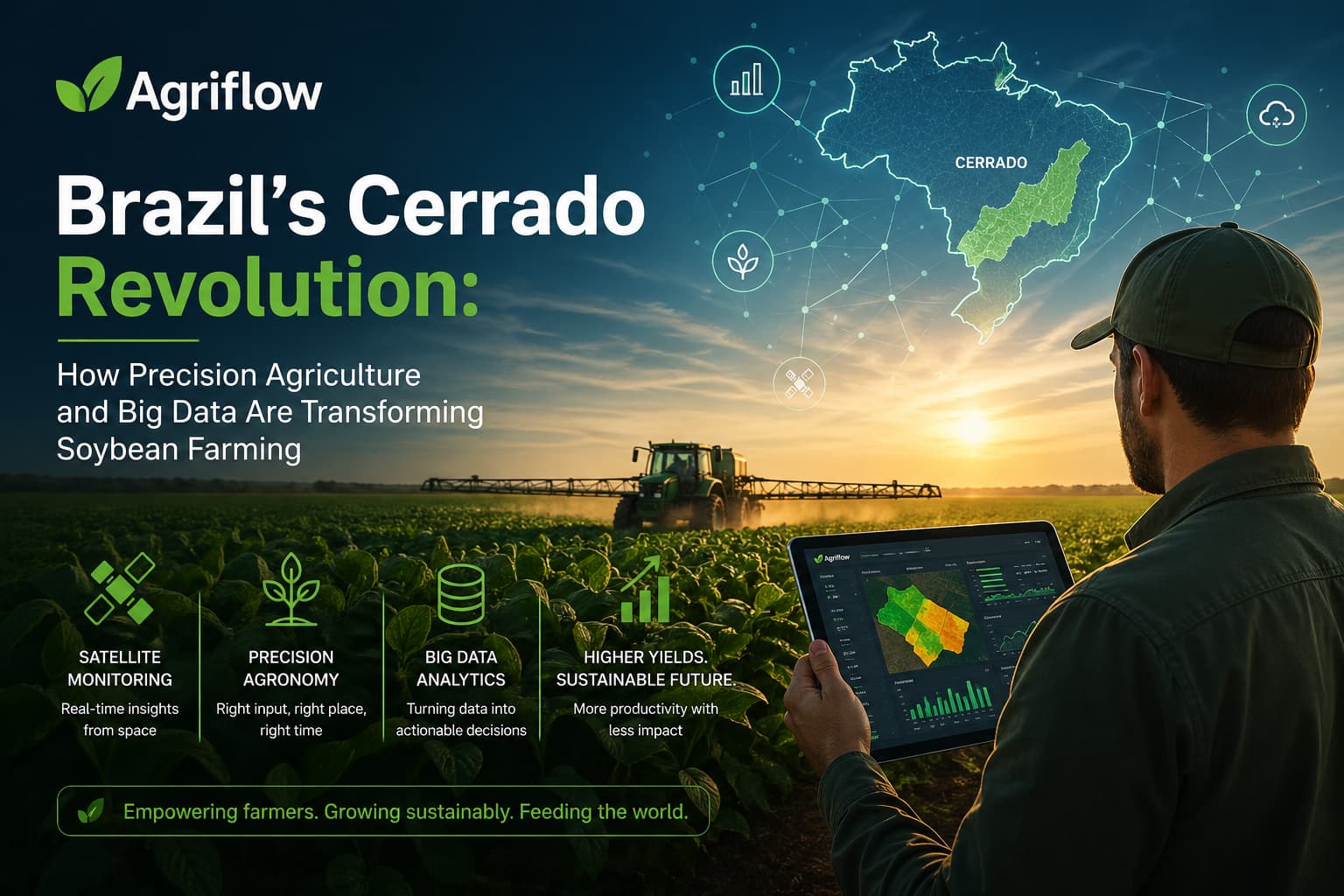
Inside the technology stack — from orbital sensors to integrated ERP platforms — that is turning the Brazilian Cerrado into the world's most productive and most scrutinized agricultural frontier.
Few agricultural transformations in modern history rival what has unfolded across Brazil's Cerrado biome over the past four decades. A vast tropical savanna once dismissed as agronomically unviable due to acidic, aluminum-saturated soils, the Cerrado now produces more than half of Brazilian soybeans and stands as the single largest contributor to global oilseed supply growth. Brazil overtook the United States as the world's leading soybean exporter in the 2010s, and according to USDA Foreign Agricultural Service data, the country produced approximately 169 million metric tons of soybeans in the 2024/25 marketing year — a figure that would have been considered fantasy a generation ago.
What is making this possible today is no longer simply land expansion or fertilizer chemistry. The defining force of the modern Cerrado is the convergence of precision agriculture, satellite-based big data, and integrated enterprise resource planning (ERP) systems capable of orchestrating operations that span hundreds of thousands of hectares. This article examines how that technology stack functions on the ground, which tools are driving yield gains, what challenges remain, and why the Cerrado has become a global laboratory for data-driven agribusiness.
Spanning roughly two million square kilometers across central Brazil — an area larger than Mexico — the Cerrado covers parts of Mato Grosso, Goiás, Tocantins, Bahia, Minas Gerais, Maranhão, and Piauí. Until the 1970s, its highly weathered Latosols were considered too acidic and nutrient-poor for grain production. The breakthrough came when EMBRAPA, the Brazilian Agricultural Research Corporation, developed liming protocols, tropical soybean cultivars adapted to low-latitude photoperiods, and inoculation strategies for biological nitrogen fixation.
By 2025, the so-called MATOPIBA region — the agricultural frontier composed of Maranhão, Tocantins, Piauí, and Bahia — has emerged as the most dynamic expansion zone, with soybean acreage growing by double digits in several municipalities each season. According to industry consultancy Agroconsult, total Brazilian soybean planted area exceeded 47 million hectares in the 2024/25 cycle, with the Cerrado contributing the dominant share of incremental growth.
This scale is precisely what makes precision agriculture not just useful, but mandatory. A single farm in Mato Grosso can exceed 50,000 hectares — larger than many European countries' total arable land. Managing operations of that magnitude without geospatial intelligence and integrated data platforms is no longer commercially viable. As we explored in our overview of agtech innovations transforming modern farms, the move from analog management to data-native operations has become the dividing line between commodity producers and tier-one agribusinesses.
The Cerrado's defining advantage today is the sheer volume of data being generated, transmitted, and acted upon during each crop cycle. A typical large-scale Brazilian soybean operation now collects information from at least seven distinct streams: satellite imagery (both optical and synthetic aperture radar), drone-based multispectral surveys, in-field IoT sensors monitoring soil moisture and temperature, telematics data from machinery, weather station feeds, harvester yield monitors, and supply chain logistics data covering grain movement to ports such as Santos, Paranaguá, and the rapidly growing northern terminals at Itaqui and Barcarena.
Together these streams routinely produce several terabytes of operational data per farm per season. The strategic question is no longer whether to collect this data, but how to integrate it into actionable decisions. This is where ERP architecture becomes decisive — and where parallels with North American grain operations, examined in our analysis of Midwest crop prediction systems, become illuminating. Brazilian operators have leapfrogged in some respects, deploying cloud-native ERP stacks with embedded machine learning where U.S. farms still run hybrid legacy systems.
The role of artificial intelligence and machine learning in agricultural decision-making has been particularly pronounced in Brazil because the operational scale justifies model development costs that smaller markets cannot amortize. Predictive yield models for the Cerrado now achieve mean absolute errors below 8% at harvest minus 60 days for many properties, allowing earlier and more accurate hedging on B3 (Brazil's commodities exchange) and CBOT contracts.
Satellite-derived intelligence forms the foundational layer. Programs such as Planet Labs' daily revisit constellation, ESA's Sentinel-2, and Brazil's own CBERS series provide continuous coverage of cropland at resolutions ranging from 30 cm to 10 meters. Vegetation indices — NDVI, EVI, NDRE, and increasingly chlorophyll-specific indices like MCARI — are computed automatically and ingested into farm management platforms. Thermal anomalies indicate irrigation failures or pest outbreaks days before they become visible from a tractor cab.
What is changing in 2025 and 2026 is the move from imagery-as-output to imagery-as-input. Modern systems no longer present growers with NDVI maps; they generate prescription files, scouting routes, and treatment recommendations directly. The grower interacts with conclusions, not pixels.
Brazil has become one of the largest drone markets in global agriculture, both for surveying and for spray application. The country approved the use of aeronaves remotamente pilotadas for agrochemical application in 2023, and adoption has been explosive. Spray drones such as those from XAG and DJI Agras now routinely cover 30 to 50 hectares per hour, applying fungicides during Asian soybean rust pressure windows when ground rigs cannot enter wet fields. The principles, regulatory considerations, and ROI calculations parallel those discussed in our examination of drone deployment in California irrigation management, though Brazilian fleet sizes per farm tend to be substantially larger.
Soil moisture probes, micro-climate stations, and grain bin monitoring sensors form the in-field nervous system of modern Cerrado operations. Networks running on LoRaWAN, NB-IoT, and increasingly 4G and 5G backhaul transmit readings every few minutes to centralized dashboards. The same fundamentals driving IoT adoption across American farming operations apply at significantly larger scale in Brazil, with single properties often deploying hundreds of sensor nodes.
Connectivity remains the bottleneck in remote MATOPIBA areas. Hybrid solutions combining LEO satellite internet (Starlink in particular) with terrestrial cellular have largely solved this problem since 2023, and field connectivity is no longer a meaningful constraint for most commercial operations.
Variable-rate fertilization, seeding, and crop protection have become standard practice across Cerrado soybean operations above approximately 5,000 hectares. Modern planters from Stara, John Deere, and Jacto can adjust seed populations on the fly based on soil texture maps and topography. Lime and gypsum applications — critical inputs in tropical Latosols — are now routinely prescribed at sub-hectare resolution, reducing input costs by 8% to 15% while improving yield uniformity.
The defining capability that separates leading Brazilian agribusinesses from average operators is not any single technology but the integration layer that binds them. A modern soybean ERP for Cerrado operations must handle agronomic planning, input procurement (often involving complex barter arrangements where soy is exchanged for fertilizer), machinery telemetry, labor management for highly seasonal workforces, regulatory reporting under the Brazilian Forest Code, financial hedging across multiple currencies, and supply chain logistics that can extend 2,000 kilometers to port.
This complexity is qualitatively different from what we documented in our coverage of Heartland soybean ERP deployments in the U.S. Midwest. American operations typically benefit from shorter supply chains, more standardized regulatory environments, and stronger bank relationships. Brazilian operations must contend with currency volatility, geographic distance to infrastructure, more complex tax structures (including ICMS variations across states), and a regulatory environment increasingly focused on deforestation traceability.
Effective Cerrado ERP architectures share several characteristics:
SLC Agrícola, listed on the B3 exchange, operates approximately 700,000 hectares across the Cerrado and is widely regarded as one of the most data-mature agribusinesses globally. The company has reported in investor communications that its proprietary management system integrates over 30 distinct data sources, with predictive analytics informing planting decisions, input procurement timing, and harvest sequencing. The result has been consistent yield premiums of 5% to 12% over regional averages, and significantly tighter cost discipline during volatile input price cycles.
Amaggi, founded by the Maggi family in Mato Grosso, combines large-scale soybean production with grain origination, logistics, and trading. Its ERP and traceability infrastructure has become particularly important as European buyers demand verifiable proof that soybeans are not linked to recent deforestation. The company has invested heavily in blockchain-based traceability, building on the principles examined in our coverage of blockchain technology and agricultural transparency. Cargoes destined for the European Union now carry digital provenance records traceable to specific polygons of farmland.
Bom Futuro, headquartered in Mato Grosso, illustrates how family-owned operations have scaled into industrial agribusinesses while maintaining tight operational control. Their use of integrated weather, agronomic, and financial dashboards has become a reference for mid-sized operators across the Cerrado, demonstrating that data sophistication is not exclusive to publicly traded firms.
No discussion of Cerrado agribusiness is complete without addressing sustainability. The biome has experienced the highest absolute deforestation rates in Brazil in recent years, surpassing the Amazon by some measures. According to the FAO's FAOSTAT database, Brazilian agricultural land use has expanded substantially since 2000, with the Cerrado bearing a disproportionate share of native vegetation conversion.
The European Union Deforestation Regulation, which entered phased application in 2025, has fundamentally restructured the data requirements for any soybean cargo destined for EU markets. Producers must now provide georeferenced polygons of every plot of origin, deforestation-free certification dating back to December 2020, and full chain-of-custody traceability. ERP systems lacking these capabilities are effectively excluded from European premium markets.
This regulatory pressure has accelerated investment in two adjacent areas. First, carbon credit programs tied to agricultural management practices are creating new revenue streams for producers who adopt no-till, cover cropping, and integrated crop-livestock-forestry (ILPF) systems. Second, principles of regenerative agriculture and the ERP infrastructure required to document it are being adopted not merely for ideological reasons but as commercial differentiators in increasingly segmented export markets.
The broader framework of climate-smart agriculture is also gaining institutional traction in Brazil, with public credit lines such as the ABC+ Plan tying preferential financing to verifiable adoption of low-carbon practices. EMBRAPA continues to publish reference protocols, and the agency's research outputs remain a critical resource for both producers and technology vendors. Practitioners interested in primary sources can consult EMBRAPA's international research portal for technical documentation on tropical soybean systems.
While the Cerrado is generally well-watered compared to semi-arid regions, La Niña-driven dry spells in southern Mato Grosso and recurrent dry spells (veranicos) during the critical pod-fill stage have caused multi-million-ton yield losses in recent seasons. The 2021/22 cycle was particularly damaging in the southern states. As a result, irrigation — historically minor in Cerrado soybean — is expanding rapidly, and the management discipline required mirrors lessons learned in arid systems documented in our analysis of water management strategies for drought-resilient cropping.
Center pivot installations in MATOPIBA grew at compound annual rates exceeding 15% between 2020 and 2024 according to industry surveys, and pivot-equipped soybean rotations with second-crop maize or cotton are becoming the highest-margin operating model in the region. ERP systems must now natively handle dual-crop accounting, irrigation scheduling, and the more complex labor and energy cost structures that come with intensification.
The technology stack described above operates on top of a continuously evolving genetic foundation. Brazilian soybean cultivars released in the past five years have increasingly stacked traits for Asian rust tolerance, nematode resistance, and drought avoidance through earlier maturity. The interplay between agronomic data systems and seed selection is becoming tighter, with platforms recommending cultivar choices based on multi-year farm-specific yield environment classifications. We have explored the broader landscape of biotechnology and crop resilience in detail; in the Cerrado context, biotech and digital agriculture are increasingly inseparable layers of the same operating system.
A soybean grown in Sorriso, Mato Grosso, may travel by truck for 1,500 kilometers before reaching a port. Logistics costs in Brazil have historically represented 20% to 30% of farm-gate price discounts versus Chicago benchmarks, and reducing this so-called Custo Brasil through improved infrastructure and routing intelligence is a major source of competitive advantage. Modern ERP systems integrate freight booking, port slot management, and real-time GPS tracking of contracted truck fleets.
Price risk management is equally critical. With production financed largely through CPRs, barter contracts, and bank credit denominated in mixed currencies, treasury and hedging functions must be integrated with agronomic planning. The methodologies applied here echo those examined in our piece on grain risk and futures ERP integration, though Brazilian operators face additional layers of currency and basis risk that demand more sophisticated treasury modules.
Several trends are likely to define the next phase of Cerrado precision agriculture:
For agribusinesses evaluating their precision agriculture and ERP roadmap, several principles consistently distinguish successful deployments from underperforming ones:
These principles are universal, but their application in the Cerrado requires unusual sensitivity to scale. Solutions designed for 500-hectare European farms simply do not extrapolate to 50,000-hectare Brazilian operations without architectural redesign.
Brazil's Cerrado is more than a regional success story. It is the global proving ground for what large-scale, data-native, sustainability-constrained agribusiness looks like in the second half of the 2020s. The combination of orbital sensing, IoT instrumentation, machine learning analytics, and integrated ERP infrastructure has transformed operations that were until recently impossible to manage at the scale they now occupy.
The challenges — deforestation pressure, climate volatility, infrastructure deficits, regulatory complexity — are equally instructive. They illustrate that precision agriculture is no longer a productivity tool alone; it is the substrate on which legitimacy, market access, and long-term commercial viability are built. Operators who treat data systems as overhead will find themselves locked out of premium markets within a few seasons. Those who treat them as the operational core will define the next decade of global agribusiness.
The Cerrado revolution is, in other words, the future of farming arriving early — and at very large scale.
For more analyses of how technology is reshaping agriculture across continents, explore our coverage of regional agribusiness transformation, from California's specialty crop operations to Ghana's cocoa value chain and India's drip irrigation modernization.

Find Agriflow in other countries of Africa